





What the song “Guantanamera” doesn’t tell you
A collaboration by Yoanna Cervera/ Photos: Guantanamo Travel
When dawn breaks in Cuba, the light always chooses the same spot to appear first: the easternmost point of the island. That’s why the people of Guantánamo proudly say that they receive the sun before anyone else, as if each sunrise were an exclusive gift. So when someone hums “Guantanamera, guajira guantanamera,” they may not realize they are unwittingly invoking the land where the day is born first. And what follows is an invitation to explore it.
The City of Guantanamo: Straight streets and much more
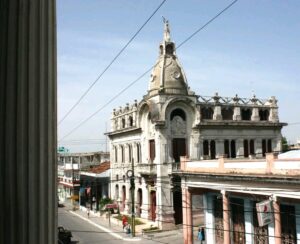
Before venturing into the mountains and coasts, it’s worth stopping in the provincial capital. Guantánamo is a city laid out in a grid pattern, with straight, wide streets that distinguish it from the colonial design of other Cuban cities. Those who walk its streets discover a unique feature: many architectural styles converge, and almost all the houses have awnings on their porches, a way to combat the intense heat. The city is known throughout the island for its vibrant culture, a cradle of musicians and renowned artists, and home to the Changüí Festival, dedicated to the region’s native rural rhythm. In Mariana Grajales Coello Revolution Square, a sculpture of the independence patriot serves as a reminder that this is also the land of the Mambisas (women Cuban independence fighters).
Baracoa: The first villa
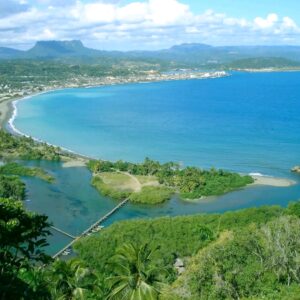
Just over three hours by road from the provincial capital, passing through La Farola, lies Baracoa. Founded in 1511 by Diego Velázquez, it is the oldest city in Cuba and the island’s first capital. Here, the Cruz de la Parra is preserved, one of the 29 crosses that Christopher Columbus brought on his first voyage and planted upon his arrival in 1492. Scientific studies have confirmed that the wood dates from the late 15th century, making it the only proven physical remnant of the admiral’s first voyage still preserved in the Americas.
The city is watched over by El Yunque, a 575-meter-high table mountain that the people of Baracoa still use as a weather forecasting reference: if there are clouds at the top, prepare for rain. Nearby flow the Toa River, the most voluminous in Cuba, stretching 130 kilometers and with a basin that is home to more than a thousand species of endemic plants, and the Miel River, which empties into the bay next to the city—a tributary so beautiful that locals say, “whoever swims in it, stays in Baracoa.”
La Farola
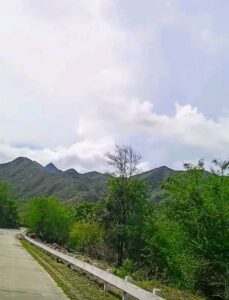
To reach Baracoa by land, you must cross La Farola, a 62-kilometer highway inaugurated in 1965 that connects the city to the rest of the country. It is considered a masterpiece of Cuban civil engineering and one of the most spectacular roads in the Caribbean. It has eleven bridges, countless curves, and a section that climbs to 600 meters above sea level, with viewpoints offering panoramic views of the Alejandro de Humboldt National Park on one side and the sea on the other. It was declared a National Monument in 2019.
Maisí and its lighthouse
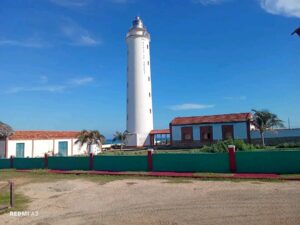
At the easternmost point of Cuba, on Punta de Maisí, stands a lighthouse that began operating in 1862. At 32 meters tall, its beams reach 28 nautical miles and it remains a vital navigational aid in the Windward Passage. The cliffs in the area plunge steeply into the sea, and nearby lies Pozo Azul, a karst formation with turquoise waters about fifteen meters deep, fed by underground springs.
To reach the lighthouse, you must travel along the more than 30 kilometers of the Maisí highway, opened in the 1970s, which lines the coast with breathtaking views.
Alejandro de Humboldt National Park
Declared a World Heritage Site by UNESCO in 2001, this park protects some 70,000 hectares (almost 700 square kilometers) of the Nipe-Sagua-Baracoa mountain range. It is one of the most important biodiversity reserves on the planet, with high levels of endemism: it is estimated that more than 70 percent of the plants it harbors exist nowhere else in the world.
Here lives the Polymita picta, considered the most beautiful snail in the world, with its colorful stripes ranging from yellow to black, passing through pink and brown. Also inhabiting the area are the Cuban solenodon or almiquí, a nocturnal insectivorous mammal that seems to have stepped out of another era; the Cuban hutia, the largest of the Cuban rodents; and dozens of bird species such as the Cuban green woodpecker, the Cuban tody, and the Cuban trogon, which bears the colors of the Cuban flag on its chest, back and wings. The vegetation includes tree ferns, orchids, and endemic palms such as Copernicia fallaensis.
Changuí and the Tumba francesa
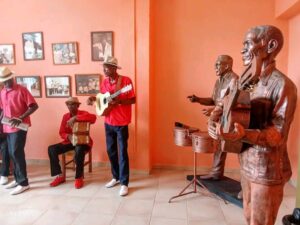
In the hills of Guantánamo, changuí was born, a rustic variant of son played with marímbula (a plucked box instrument), bongos, güiro (percussion instrument), and vocals, which still enlivens local celebrations in the area. But Guantánamo is also a land of Haitian heritage: the Tumba francesa, declared a Masterpiece of the Oral and Intangible Heritage of Humanity by UNESCO in 2003, is a musical and dance expression brought by slaves who arrived from Haiti at the end of the 18th century.
In the city of Guantánamo, the Tumba Francesca La Pompadour Society, founded in 1886, keeps the tradition alive with its long drums (the manmá and the bulá), its songs in Creole, and its dances with wide skirts.
El Guirito
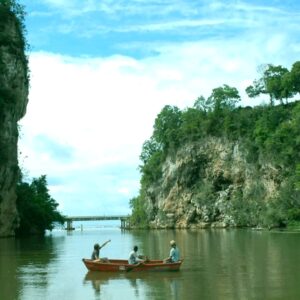
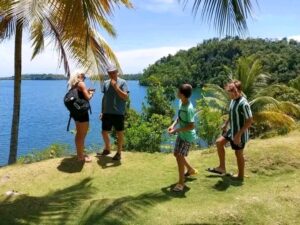
Neither a dance nor an instrument: El Guirito is a rural community located about 10 kilometers from Baracoa, on the north coast. Its inhabitants, descendants of fisherpeople and farmers, live in a landscape of great beauty where the mountains reach the seashore. The area is known for the simplicity of its daily life and for preserving traditions linked to fishing and coconut growing.
Zoológico de Piedras
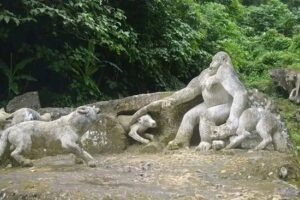
In the municipality of Yateras, about 35 kilometers from the city of Guantánamo, lies the “Stone Zoo.” It is not a whim of nature: it was a dream sculpted by Ángel Íñigo, a farmer turned naïve artist who in 1977 began carving the rocks on his farm with simple tools, giving them the shapes of animals. Upon his death in 1993, his son Ángelito continued the work. Today, the site boasts more than 400 figures distributed across an area of about two hectares: elephants, camels, turtles, dinosaurs, lions, birds, and other species emerge from the stone amidst the vegetation, in an unusual dialogue between human creation and the natural landscape. The place is one of a kind in Cuba and attracts hundreds of visitors every year.
The people
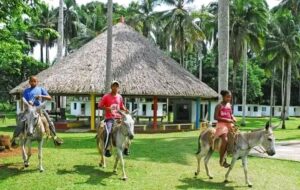
The people of Guantánamo speak with a musical cadence; they have a way of saying things that makes you want to stay. They ask how you are, and they genuinely want to know. They offer you coffee, point out the way, tell you a story their grandfather told his father, and his father told him. They are people made of mountains and sea, of resilience and joy, of that unique blend found only in Cuba.
So when someone hums “Guantanamera, guajira guantanamera” again, perhaps it won’t just be a tune anymore. Perhaps it is an invitation to drop by that province that receives the sun before anyone else, that has a city of straight streets with awnings in the doorways, the oldest cross in America, a lighthouse at the end of the world, a unique spiral, 700 square kilometers of primeval nature, a road that is a monument, 400 stone figures sculpted by a farmer and a memory that dances to the rhythm of French drums.

MORE NEWS

SUBSCRIBE TO OUR NEWSLETTER
TTC News

WE ARE IN SOCIAL NETWORKS