





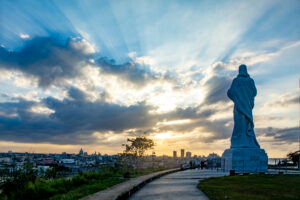
The Christ of Cuba, standing on a Havana hilltop
A collaboration by Yoanna Cervera/ Photo: Abel Rojas Barallobre
An image surprises the curious passerby: suddenly, it seems as if they are in Rio, very close to that famous sculpture. But no, we are in Cuba, although also close to a Christ, but in Havana. The same figure with open arms, the same protective gesture; but the sea seen from below is different, the heat is different, and its history is different too.
The Christ of Havana peeks out from the La Cabaña hill, right at the entrance to the bay. Rather than at the top of a mountain, it stands on a hilltop overlooking the Malecón seawall and the historic center of the Cuban capital. With its 20 meters of white marble, it looks imposing, as if it might start walking at any moment.
The story of this sculpture is curious. It is the work of Jilma Madera, a Cuban artist who received the commission in the 1950s. They say that the wife of then-President Batista wanted a gift for the church, and the work was crafted from Carrara marble, the same marble used by Michelangelo. It was inaugurated in 1958, a year before the triumph of the Cuban revolution. So, from its pedestal, Christ witnessed the entire country’s transformation.
The construction of this giant wasn’t a matter of a month; it lasted almost two years. The stones, 67 blocks of white Carrara marble, traveled by ship from Italy to Havana. Italian sculptors carved each piece there, numbered them like a jigsaw puzzle, and then assembled them on a steel structure on the island. They say that the Cuban and Italian workers barely understood each other when talking, but they communicated everything with their hands.
And like any monument of this kind, this Christ has its legends. Old-timers in Havana say that when a hurricane approaches the city, the gaze of the statue intensifies, as if it were blowing to deflect the wind. It’s also said that whoever climbs the steps to reach him backward and makes a wish without looking back will have that wish granted. Such is folklore; you have to try it to know for sure.
What connection does it have with other Christ statues around the world? According to historical records, Jilma Madera herself traveled to Brazil before creating her own, where she saw Christ the Redeemer, studied its dimensions, and breathed in its grandeur, but decided not to copy it. That’s why the one in Havana is smaller, more serene, and faces the sea instead of the jungle. Today, other giant Christ statues stand in Bolivia (the Christ of Concord in Cochabamba, the tallest in the Americas), in Colombia, in Venezuela, and even in Spain, such as the Christ of Otero in Palencia. They all share a similar expression, but each one watches over its city in its own way.
Today, this Christ has become a tourist attraction. Getting there is a simple adventure: you can take a car or walk up the road that skirts the bay. Once at the top, the reward is a 360-degree view. From here you can see the Capitol Building, El Morro, and the ships coming and going through the bay. At sunset, the sun dips behind the city, and Christ becomes a golden silhouette.
Travelers who arrive in Havana usually go to the Malecón, Plaza Vieja, and the Floridita, but few take the time to climb up to see Christ the Redeemer. That’s a mistake, because from that vantage point, with his arms outstretched over the sea, you understand why locals call him “the protector.” He’s not just a statue; he’s a symbol that watches over, that withstands hurricanes and the passing of time, that remains steadfast.
So now you know: if you go to Havana, find a free afternoon, cross the bay tunnel, and climb up to La Cabaña. You can also take the well-known ferry from Regla that crosses the bay and walk there. Christ the Redeemer will be waiting for you with the same gaze as always, as if he knows that, in the end, all the paths of the island pass beneath his feet.

MORE NEWS



SUBSCRIBE TO OUR NEWSLETTER
TTC News

WE ARE IN SOCIAL NETWORKS