






109 visits to Cuba: The story of Ursula, a Canadian who found a second family in the Caribbean

By: Rachell Cowan Canino /Photos: Courtesy of the interviewee
Some travelers have been to Cuba once. Others, five times. Some, 20. And then there’s Ursula Kunstmann.
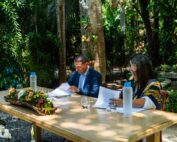
She is 88 years old, speaks three languages, for decades her husband (who passed away two years ago) was her travel companion, and today she has made 109 visits to Cuba. The first was in the early 1980s, when the country was just beginning to open up to international tourism and the hotels available to Canadians could be counted on one hand.
That’s why, when she says “we” in this interview, it should be understood as a plural that still holds memories. “Let’s get started,” she writes to me before we begin, with the modesty of someone apologizing for her English—it’s her third language—and the patience of someone who has lived almost nine decades.
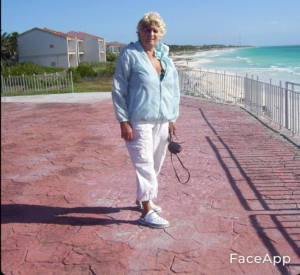
109 trips to Cuba is a lot. Did you imagine the first time you came that this country would become so important in your life?
“Those early trips were very different from what Cuba is today. We stayed at the Balneario del Sol, an hour east of Santiago de Cuba. It was the only hotel available to Canadians. Very basic: rooms with two single beds, a shower, a sink and a toilet. The meals were always the same, day after day. Drinks cost 55 cents: rum and Coke, beer. Everything was paid for in US dollars. No tipping was allowed.
But something was happening there. Cuba already had plans to build more hotels and was training its staff at that small resort. Over the years, we’ve run into employees from that time who now hold important positions in the hotel chain. Watching them grow has been exciting.”
You’ve said on more than one occasion that “it’s the people who make you come back.” Could you tell us an anecdote or about a special moment when you felt that Cubans treated you like one of the family?
In general, Cubans are very kind, hospitable, have a great sense of humor, love to laugh, and share what they have without expecting anything in return. They would give you the shirt off their back if you needed it.
Once we rented a car at the hotel—something that was possible later on—and ventured off the main roads. On a dirt road, in the middle of fields, we ran out of gas. A man who worked nearby approached us and asked if he could help. He told us there weren’t any gas stations nearby, but that he could get us some. He took us to his house, a very small Cuban home, while he went to get the fuel. His wife offered us soft drinks—to us, complete strangers. With our limited Spanish, we started talking, and soon they were showing us pictures of their large family.
The man returned at dusk with a can of gasoline. He refused to accept money. He drew us a map to a gas station. We wanted to leave, but the family insisted we stay the night because it was already dark and difficult to find our way in that area. That’s the Cuba I know. Once you spend time in a Cuban home, you become part of the family and have friends for life.”
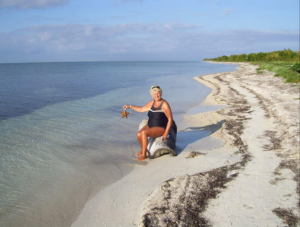
Over so many years, you’ve seen Cuba change a lot. Is there anything different you’ve noticed on your most recent visits? And what, for you, remains just as authentic as always?
“The changes in tourism are something no one could have imagined. We went from very basic Cuban hotels to the most luxurious resorts, operated by renowned international hotel chains. That improved the availability of food and almost everything else.
The introduction of tipping was welcomed, but importantly, it didn’t change the way the staff treats guests. With or without a tip, the service, the friendly smile, and the attention are the same. That hasn’t changed.”

You always travel with Hola Sun Holidays, who even gave you a special welcome on your 109th trip. What do you value most about your tour operator?
“Hola Sun Holidays was founded in Canada in 1991. It’s a Canadian company and It is the touroperator specialized in the destination Cuba. Since our first trip with them, on their inaugural route to Santiago, we’ve booked with Hola Sun whenever possible. They are very professional, friendly, and helpful. Any problem we’ve had has been resolved quickly and satisfactorily.
Unlike other tour operators, Hola Sun always has an employee at Toronto airport to assist with check-in; a much-appreciated service. Upon arrival at the Cuban airport, you can easily spot the Hola Sun representative in their blue shirt, who guides you and helps you board the bus. Another representative accompanies people on the bus to the hotel, pointing out interesting sights and providing helpful information about the hotel and excursions along the way. I highly recommend the entire team, both Canadian and Cuban, at Hola Sun Holidays.
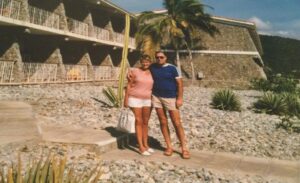
Safety is something Canadian travelers value highly. Do you still feel that Cuba is a destination where a woman traveling alone or an older woman can move around with complete peace of mind?
“Safety is very important when traveling. From the beginning, I felt safe walking the streets anywhere in Cuba: Havana, Santiago, Trinidad, Matanzas, Manzanillo. Even in the dark of night. I’ve been to Mexico, Panama, Honduras, Colombia, the Dominican Republic, and in those countries I wouldn’t feel safe even leaving the resort, let alone at night.”
If you had to convince a Canadian friend or neighbor who has never been to Cuba to go this year, what would you say?
“I’ve recommended Cuba to many friends and family members. I often get calls from people who are thinking about going. I always ask them what kind of vacation they want: beach, Cuban culture, history. Based on that, I advise them as best I can from my experience. Most have become regular travelers. They come back again and again.”
After 109 trips, you surely have Cuban friends scattered all over the island. Is there anyone particular you always greet when you arrive?
“I’ve traveled from north to south and from east to west. I’ve stayed in everything from small Cuban hotels to luxury resorts and private homes. That has given me many true, lifelong friends, both high-ranking officials and ordinary people. There are so many that I don’t want to mention anyone in particular. I love them all and feel privileged to be able to call them friends.”
After the interview, Ursula sends me one last message. She apologizes if anything isn’t clear, explaining that English is her third language. I smile and ask her when she’ll be back. “If my health allows, I’ll return to Cuba as soon as possible. I’d love to go to the Trinidad area.” She’s perfectly understandable because she speaks a universal language: the language of love.
This interview was originally published in issue no. 319 of TTC, dedicated to FITCuba 2026.

MORE NEWS



SUBSCRIBE TO OUR NEWSLETTER
TTC News

WE ARE IN SOCIAL NETWORKS