






Guacamaro’s Tour: Sustainable tourism with a community focus in Matanzas
By: Rachell Cowan Canino /Photos: Courtesy of the project
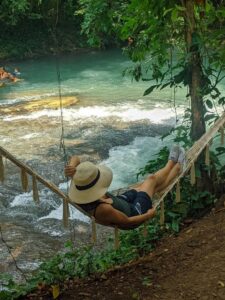
There are places you visit and places you inhabit, even if only for a few hours. Guacamaro’s Tour belongs to the latter category. Just a stone’s throw from Varadero, Cuba’s main beach resort, this Local Development Project (LDP) is rewriting the tourism narrative in the province of Matanzas, demonstrating that beyond the bridges and all-inclusive hotels, there is a profound, authentic, and transformative Cuba.
We are greeted by Judith Rodríguez Reyes, the project director, in a setting that could well be the prelude to the experience: the intense green of the Matanzas mountains serves as a backdrop while the first birdsong announces that here, nature sets the pace. Judith is not your typical hotel executive; she comes from the world of rescue and the Red Cross, and the perspective of someone who has learned to value every life permeates her entire philosophy.
“My experience as a Red Cross rescuer taught me that every life is a unique and irreplaceable universe,” she begins. “At Guamacaro’s Tour, we’ve applied that vision to heritage: protecting the memory of landscapes, traditions, and local stories is also a way to save what gives us identity and meaning. It’s about rescuing the intangible so that it stays alive.”
From scientific discovery to human encounter
Guacamaro’s Tour was born from a speleological group—those scientists and explorers who for years explored caves and mountains, documenting everything. How did the leap from science to tourism happen? Judith clearly explains it: “The ‘click’ happened when we realized that the findings had to be shared. Showing the world what we were discovering—caves, coffee plantations, and historical routes—became an act of responsibility and an opportunity for sustainable development for the community.”
The project’s name is also no coincidence. “Guamacaro is a word with indigenous roots that evokes territory, water and mountains,” she explains. “We chose it because it sums up our essence: a project that connects nature, history and spirituality, and that seeks to make each visitor feel part of that heritage.”
Three routes to read the landscape
Guacamaro’s Tour currently offers two established routes and a third that promises to become a landmark of Cuban hiking.
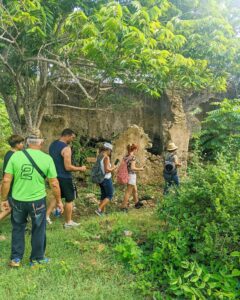
The Coffee Route explores the ruins of a 19th-century coffee plantation, but it’s not just a simple walk among the plants. “This route is an open book about economics, slavery, resistance, and culture,” explains Judith. And here the question inevitably arises of how to approach the thorny issue of slavery.
“We approach it with respect and historical rigor. We don’t seek sensationalism or escapism, but rather understanding. We explain how slavery shaped the economy and daily life, and how its legacy still resonates. It’s an exercise in memory that dignifies those who experienced that reality.” With well-trained guides, visitors learn to pause, observe, and discover layers of meaning that transform the experience.
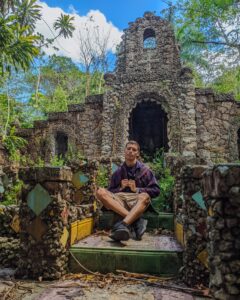
On the other hand, the Energy Route holds an unexpected gem: the “Casa de los Caracoles.” Judith pauses when speaking about this place, and it’s clear it’s not just another stop on the tour. “It’s a symbolic space where nature and faith intertwine,” she says with a smile that hints at mystery.
“The Casa de los Caracoles was born from a promise of faith. A sick teacher offered to cover his home with seashells and sea stones to honor Our Lady of Charity of El Cobre, and thus he erected a unique sanctuary in Cuba that today is a symbol of devotion, folk art, and cultural heritage.” Those who visit it say that “the seashells still whisper the story of a man who transformed his promise into an eternal legacy.” It’s not a conventional tourist stop: “It’s a place that invites introspection and inner renewal.”
The big news will arrive in August 2026: “Along the Paths of History,” the first certified trekking route in Matanzas, with a 10-kilometer trail. “All our routes are approved and certified, which guarantees safety and quality standards,” Judith explains. “But for us it means more: preparing the traveler for a journey that is both physical and spiritual. “Along the Paths of History” challenges the body, but above all it opens the mind and the heart.”
Community management model: Local power
For Travel Trade Caribbean readers specializing in the tourism business, understanding the Local Development Management model is key. Judith doesn’t shy away from the challenges.
“Managing tourism from the community level implies autonomy and commitment. The advantage is that the benefits stay within the territory and strengthen local identity. The challenge is logistics: without the backing of a large chain, every step requires creativity and collective effort.”
It is precisely this collective effort that has allowed for something that might seem contradictory: transforming local residents into guardians of their heritage. “Before, there was indifference and even plundering,” she confesses. “The key has been education and participation: when people discover that their surroundings have historical value and can generate development, they see it in a new light. Turning local residents into guardians of their heritage is our greatest achievement.”
One of the most interesting aspects for the tourism market is the strategic location of Guacamaro’s Tour, at the gateway to Cuba’s main sun and beach resort area. Have they considered involving Varadero hotels in offering day trip packages?
Judith’s answer is emphatic and hopeful: “Yes, we have. The proximity to Varadero opens up the possibility of day trips. The difficulty lies in coordinating transportation and getting hotels to integrate rural experiences into their offerings. But we believe it’s feasible and enriching for both destinations.”
And she reveals a crucial detail: “We already have direct contracts with agencies of the Cuban Ministry of Tourism, which has allowed us to receive tourists from Varadero on our excursions, strengthening the integration between the tourist hub and the rural experiences we offer.”
When Matanzas is mentioned, the collective imagination of travelers is often limited to the city of bridges or, at best, the road to Varadero. Changing that perception is one of the biggest challenges. “Breaking the stereotype means showing that Matanzas is not just bridges or the road to Varadero. It’s coffee plantations, caves, rivers, and vibrant communities. It’s a destination where rural authenticity becomes a transformative experience for the traveler,” Judith states.
To conclude, we pose the key question: If you had to convince a German or Canadian tour operator to include Guacamaro’s Tour in their portfolio, what would your definitive selling point be in a single sentence?
Judith pauses for a few seconds, looks at the surrounding landscape, and responds with the confidence of someone who knows what she offers: “Guacamaro’s Tour: A journey where nature, history and community come together to transform the traveler.”
And perhaps therein lies the key to this project: showcasing, transforming, and preserving memories. At Travel Trade Caribbean, we will closely follow the evolution of Guacamaro’s Tour, a project that demonstrates that sustainable and community-based tourism is not only possible in Cuba, but can also become a top-tier tourism export product.

MORE NEWS

SUBSCRIBE TO OUR NEWSLETTER
TTC News

WE ARE IN SOCIAL NETWORKS